This is my problem, the code, and the final running screenshot. During the iterative process, the optimal value fluctuates greatly, but it doesn’t converge. Even the differences between them are quite large. I tried using different solvers, but the problem still persists. How can this be solved?
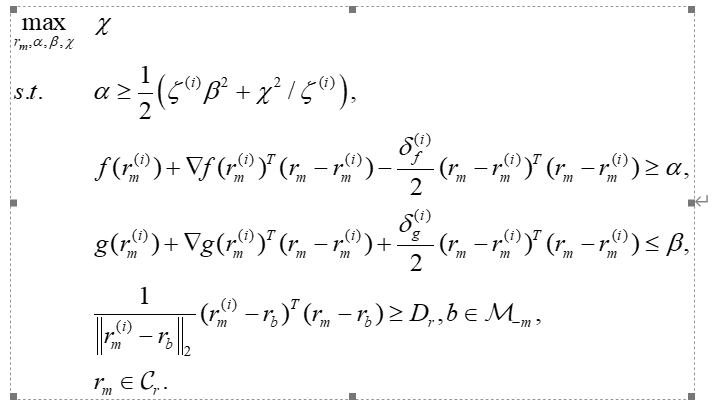
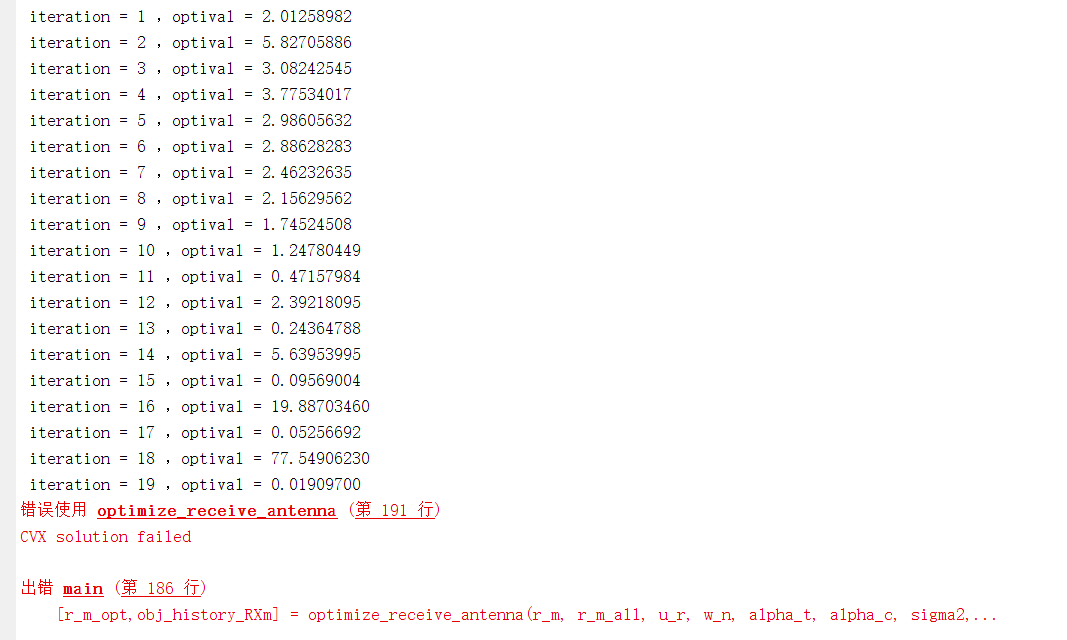
Even after the gap was further widened, CVX simply crashed.
function [r_m_opt,obj_history] = optimize_receive_antenna(r_m, r_m_all, u_r, w_n, alpha_t, alpha_c, sigma2, C_r, D, lambda, m, F_rd, h_td, h_tc, F_rc, g_rd, g_rc, L_path, theta_rdp, phi_rdp, theta_rcp, phi_rcp, L, N, M, zeta)
max_iter = 200;
tol = 1e-2;
r_current = r_m;
obj_history = zeros(max_iter, 1);


for iter = 1:max_iter
    [f_rm, grad_f, g_rm, grad_g, delta_f, delta_g] = calculate_f_g_delta_function(r_current, r_m_all, u_r, h_td, h_tc, w_n, alpha_t, alpha_c, lambda, m, F_rd, F_rc, g_rd, g_rc, L_path, theta_rdp, phi_rdp, theta_rcp, phi_rcp, L, N, sigma2);

    cvx_begin quiet
    cvx_solver mosek
    cvx_precision high
        variable r(2)
        variable alpha_f nonnegative
        variable beta_g nonnegative
        variable chi nonnegative
        maximize chi

        subject to
            alpha_f >= real(1/2*(zeta*(beta_g)^2 + (chi)^2/zeta))
            f_rm + grad_f.'*(r - r_current) - 0.5*delta_f*sum_square(r - r_current) >= alpha_f
            g_rm + grad_g.'*(r - r_current) + 0.5*delta_g*sum_square(r - r_current) <= beta_g
            r(1) >= C_r(1,1)
            r(1) <= C_r(1,2)
            r(2) >= C_r(2,1)
            r(2) <= C_r(2,2)

            for i = 1:M
                if i == m
                    continue;
                else
                    r_other = r_m_all(:, i);
                    dist = norm(r_current - r_other);
                    (r_current - r_other)' * (r - r_other) / dist >= D
                end
            end
    cvx_end

    if strcmp(cvx_status, 'Solved')
        zeta = real(beta_g) / max(real(chi), 1e-12);
        obj_history(iter) = cvx_optval;
        r_current = r;
        r_m_all(:, m) = r;

        if iter > 1
            obj_change = abs(obj_history(iter) - obj_history(iter-1));
            if obj_change < tol
                break;
            end
        end
    else
        error('CVX solution failed');
    end
end

r_m_opt = r_current;
end