Hello, everyone!
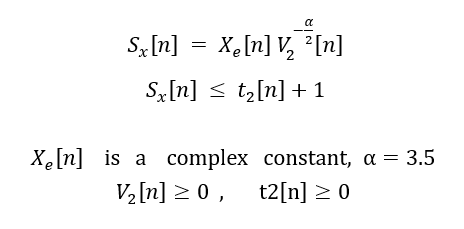
I express the constraint as follows, I want to know whether it is right?
square( pow_pos( V2(n),-a/2) + pow_pos(V3(n),-1) ) <=constant

Hello, everyone!
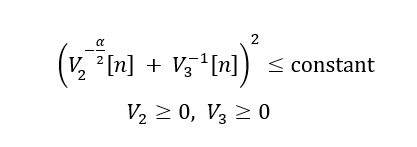
I express the constraint as follows, I want to know whether it is right?
square( pow_pos( V2(n),-a/2) + pow_pos(V3(n),-1) ) <=constant
Use pow_p, not pow_pos. For the 2nd term, you also could use inv_pos
help pow_pos
pow_pos Power of positive part.
pow_pos(X,P) = POS(X).^P = MAX(X,0).^P.
Both P and X must be real, and P must be greater than or equal to 1.Disciplined convex programming information: pow_pos(X,P) is convex and nondecreasing in X; so when used in CVX expressions, X must be convex. P must be constant, real, and greater than or equal to 1.
help pow_p
pow_p Positive branch of the power function.
pow_p(X,P) computes a convex or concave branch of the power function:
P < 0: pow_p(X,P) = X.^P if X > 0, +Inf otherwise
0 <= P < 1: pow_p(X,P) = X.^P if X >= 0, -Inf otherwise
1 <= P : pow_p(X,P) = X.^P if X >= 0, +Inf otherwise
Both P and X must be real.Disciplined convex programming information: The geometry of pow_p(X,P) depends on the precise value of P, which must be a real constant: P < 0: convex and nonincreasing; X must be concave. 0 <= P < 1: concave and nondecreasing; X must be concave. 1 <= P : convex and nonmonotonic; X must be affine. In all cases, X must be real.
Thank you for your reply, I have modified my code.
But have another problem about ‘‘Cannot perform the operation: {complex affine} . {convex}*’’. The constraint and my code are as follows:
Sx(n) = Xe(n) * pow_p( V2(n) , - alpha ) ;
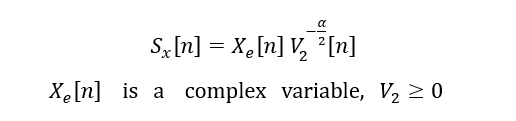
That is non-convex. it would be non-convex (neither convex nor concave) even if X were real rather than complex. It would be non-convex, even if V were not raised to any power.
I don’t know how S is used in your model, so I can’t conclude that the model is non-convex. Perhaps there is a way of reformulating the code so as to never form S, but quite possibly, such a reformulation is not possible.
Your first task is proving the optimization problem is convex.
If Xe(n) is a positive constant, that is a convex inequality. If it is not, that does not look like a convex inequality. Please carefully read the link in my previous post.
Did you pay attention the the part about the constraint needing to be convex, and proving that it is?