
错误使用 .* (line 262) Disciplined convex programming error: Invalid quadratic form(s): not a square
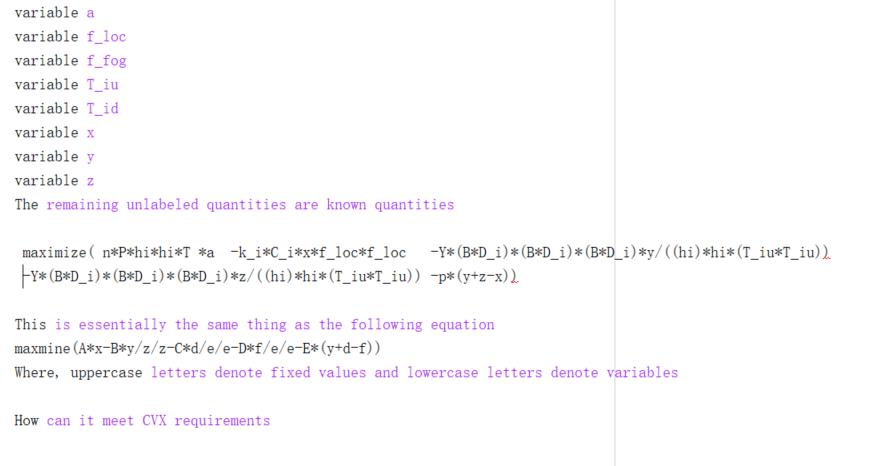
I have no idea what the formula is. Does the objective function evaluate to a scalar? Have you proven it is convex (of course it must be real, scalar), i.e., the quantity being maximized is concave?
If your function is of the form y/z^2, that is neither convex nor concave, even for y >= 0, and therefore can’t be used in CVX.
If after doing this, you still have a problem worthy of presentation, please copy and paste text of the code, using Pre-fromatted text icon. Do not just show us images.
Thanks,Mark
In fact, this is all of my code. In this article, the author changed the values of x,y,z, which were originally 0,1, into continuous variables. If the y/d^2 form is not considered convex, then how do I modify this form to be accepted by CVX
cvx_begin
variable a
variable f_loc
variable f_fog
variable T_iu
variable T_id
variable x
variable y
variable z
T=0.5;
n=0.51;
B=1.1;
E0=0;
Y=10^-23;
k_i=10^-29;
D_i=3000;
q_i=1000; ,
C_i=D_iq_i;
O_i=2;
F_fog=410^9;
F_loc=10^9;
F_cloud=2.510^9;
N_0=10^-12;
R_cf=510^6;
w=35000;
hi=510^-4;
R_max=wlog(1+30hi^2/N_0);
R=310^6;
P=3;
Ej=0.01;
Hj=0.2;
Bj=0.01;
ej=0.0001;
p=500;
M=500;
a_=0.5;
f_loc_=0.5*10^9;
maximize( n*P*hi*hi*T *a  -k_i*C_i*x*f_loc*f_loc   -Y*(B*D_i)*(B*D_i)'*(B*D_i)*y/((hi)*hi*(T_iu*T_iu))  -Y*(B*D_i)*(B*D_i)*(B*D_i)*z/((hi)*hi*(T_iu*T_iu)) -p*(y+z-x))


subject to
x+y+z==1;%%C4
f_fog<=F_fog;
f_fog>=0;
f_loc>=0;
f_loc<F_loc;
(1-x)*B*D/R<=T_iu;
 (1-x)*B*D/R_max<=T_id;
 a<=1;
 a>=0;
   x<=1;
 x>=0;
   y<=1;
 y>=0;
   z<=1;
 z>=0;

10^9/(f_loc)^2+1/10^9/(1-a)^2 <= (2*T(1-x)*M+1)/C_i ; % C_2a
B*C_i*(10^9/(f_loc)^2+1/10^9/(1-a)^2)+   (0.2/2/(1-a)^2+(T_iu+B*D_i/R_cf)^2/0.5/0.2)+    (0.2/2/(1-a)^2+(T_id)^2/0.5/0.2) <=2*T*((1-y)*M+1)

(0.2/2/(1-a)^2+(T_iu+B*D_i/R_cf)^2/0.5/0.2)+    (0.2/2/(1-a)^2+(T_id)^2/0.5/0.2)   +2*((B+o_i)/R_CF+B*C_i/F_cloud)/(1-a) <=2*T*((1-y)*M+1)

 0.5*k_i*C_i(a_*(f_loc_)^2/a^2+f_loc^4/a_/f_loc_^2)+0.5*(a_*t_/a^2+t^2/a_/t_)-0<=n*P*hi^2*T*((1-x)*M+1);   %C 11a

 0.5*Y*(B*D_i)^3*(T_iu_^2/a_/T_iy^4+a_/T_iu^2/a^2)/h_i^2+0.5*(a_*t_/a^2+t^2/a_/t_)-0<=n*P*hi^2*T*((1-y)*M+1);


   0.5*Y*(B*D_i)^3*(T_iu_^2/a_/T_iy^4+a_/T_iu^2/a^2)/h_i^2+0.5*(a_*t_/a^2+t^2/a_/t_)-0<=n*P*hi^2*T*((1-z)*M+1);
cvx_end