How to solve 'Index beyond matrix dimension'?

Uncategorized
Apr 1, 2022
Y

hi,
I encountered problems when using cvx, and the code is as follows :

cvx_begin
variable   W_W(N,N)  semidefinite
variables   t0 t(K,1) p_p(K,1);
expressions R1(K,1) R2(K,1) R3(K,1) R4(K,1) R5(K,1)
for k=1:K  
 (delta^2)/p_p(k,1)/(g(k)^2))+rel_entr((t(k,1)^2)*(delta^2)/p_p(k,1)/(g(k)^2),t(k,1)+(t(k,1)^2)*(delta^2)/p_p(k,1)/(g(k)^2)))/log(2); 
    %R1(k,1)=t(k,1)*log(1+p_p(k,1)*g(k)^2/(t(k,1)*delta^2))/log(2);
    R1(k,1)=-rel_entr(t(k,1),p_p(k,1)*g(k)^2/delta^2+t(k,1));

end
for k=1:K
    R2(k,1)=p_p(k,1);
    R3(k,1)=(t0+t(k,1))*PkC;
    R4(k,1)=t(k,1)*PIR;        
end 
    R5(1,1)=chi*(G1*W_W(N,N)*G1');
    R5(2,1)=chi*(G2*W_W(N,N)*G2');
maximize sum(R1)-eta*(sum(R2)+t0*(PPS+N*Pe)+sum(R3)+sum(R4)+trace(W_W(N,N))-sum(R5));
subject to
  t0+sum(t)<=T;
  t0>=0;
  trace(W_W(N,N))<=t0*Pmax;
  for k=1:K
    t(k,1)>=0;
    p_p(k,1)+PkC*(t0+t(k,1))<=chi*(G1*W_W(N,N)*G1');
    R1(k,1)>=Rkmin;  
  end
  cvx_end

The error shown is as follows:
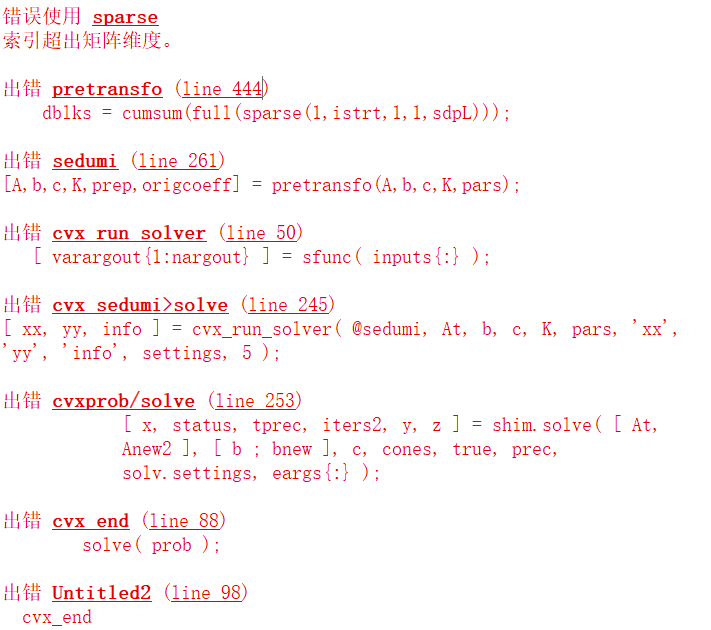

Error using sparse
Indexes exceed the matrix dimension.

Error pretransfo ( line 444 )
dblks = cumsum ( full ( sparse ( 1, istrt, 1,1, sdpL ) ) ) ;

error sedumi ( line 261 )
[ A, b, c, K, prep, origcoeff ] = pretransfo ( A, b, c, K, pars ) ;

Error cvx _ run _ solver ( line 50 )
[ varargout { 1 : nargout } ] = sfunc ( input { : } ) ;

Error cvx _ sedumi > solve ( line 245 )
[ xx, yy, info ] = cvx _ run _ solver ( @ sedumi, At, b, c, K, pars, ’ xx ', ’ yy ', ’ info ', settings, 5 ) ;

Error cvxprob / solve ( line 253 )
[ x, status, tprec, iters2, y, z ] = shim.solve ( [ At, Anew2 ], [ b ; bnew ], c, cones, true, prec, solv. settings, eargs { : } ) ;

Error cvx _ end ( line 88 )
solve ( prob ) ;

Error Untitled2 ( line 99 )
cvx _ end

I set the breakpoint before the line cvx _ end, and the operation will not report errors. But as long as it runs to cvx _ end, the error will be reported.
I don ’ t know how to solve it, please help me!


J

Try re-open MATLAB. Please translate the error to English if convenient.

Y
Replying to #2

Thank you, but restart matlab is still wrong. Shows that the index exceeds the matrix dimension.

M

Perhaps another version of sparse (such as from YALMIP) other than the built-in MATLAB versions, is in your MATLAB path ahead of the CVX method.

What is the output from
which -all sparse

You can try moving all of the CVX items to the top of your MATLAB path. If that doesn’t resolve things, try reinstalling MATLAB in a new MATLAB session. And make sure to use CVX 2.2 (not 3.0beta).

Y
Replying to #4

Thank you for your comments. This is what I ’ m showing here. Do I need to move it ?

M

It looks o.k. My recommendation at this point is to try the reinstall of CVX 2.2 in a new session. it appears that something is screwed up in your installation.

Does it work with SDPT3? Mosek (if you have it)?

Y
Replying to #6

Thanks,but I didn 't install anything except cvx, my version is 2.2

M

Have you tried reinstalling CVX, in a new MATLAB session?

Y
Replying to #8

No, I ’ ll try it now.

Y
Replying to #8

I just tried, still showing the same mistake. :cry:

M

Please show us all output, not just the error message.

Y
Replying to #11

This is all its output, Chinese translation in the text

M

Try using Mosek. if that is not available, try installing CVXQUAD and its exponential.m replacement. CVXQUAD: How to use CVXQUAD's Pade Approximant instead of CVX's unreliable Successive Approximation for GP mode, log, exp, entr, rel_entr, kl_div, log_det, det_rootn, exponential cone. CVXQUAD's Quantum (Matrix) Entropy & Matrix Log related functions

Either of these ways will avoid CVX’s successive approximation method.

Y
Replying to #13

Thank you for your suggestion. I ’ ll try it.

Y
Replying to #13

Installing mosek still doesn 't solve the problem, will it be my code problem ?

J
Replying to #15

Use Mosek as solver. Then show all your output, please. Also, if you don’t mind, maybe provide your code and data, for the purpose of reproducing.

Y
Replying to #16

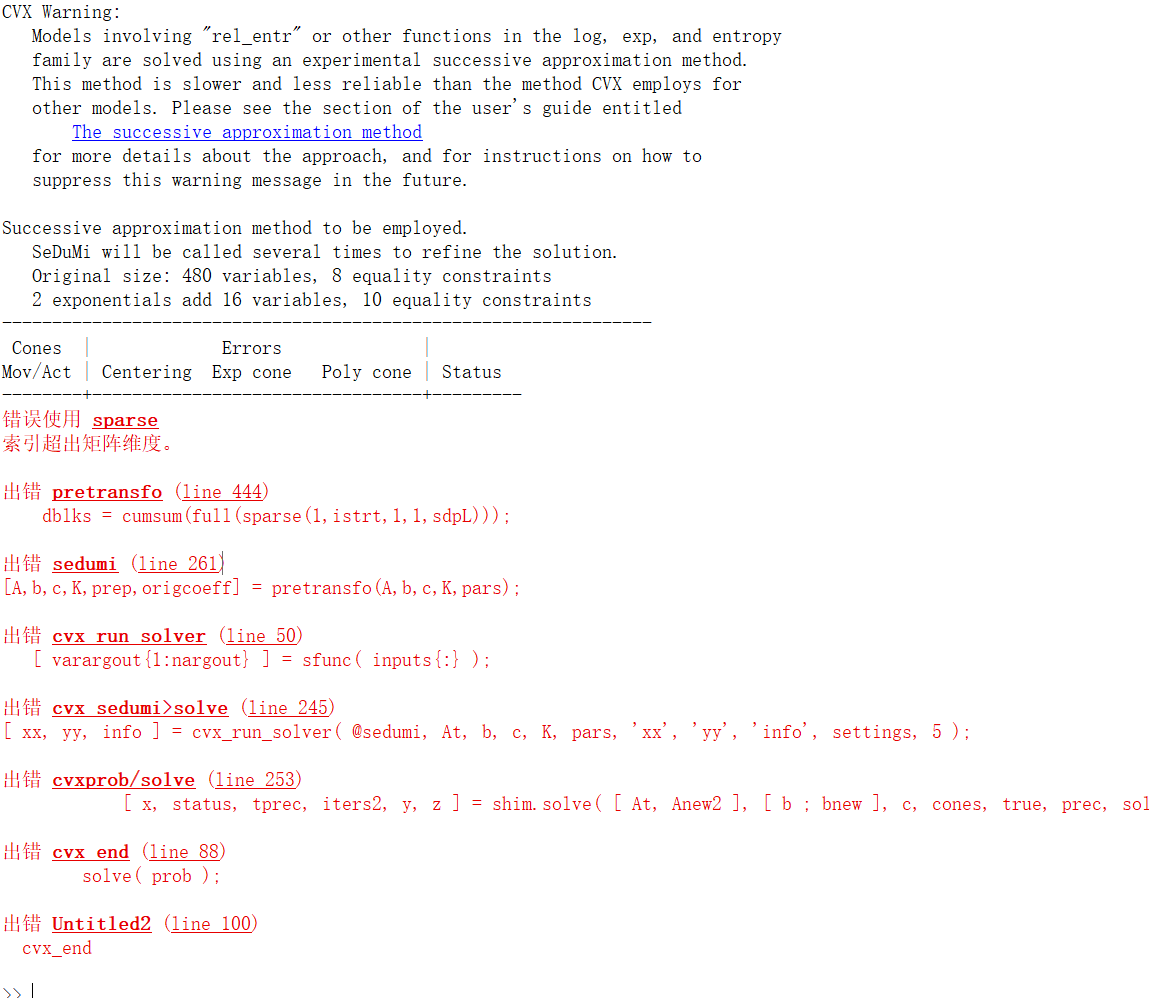
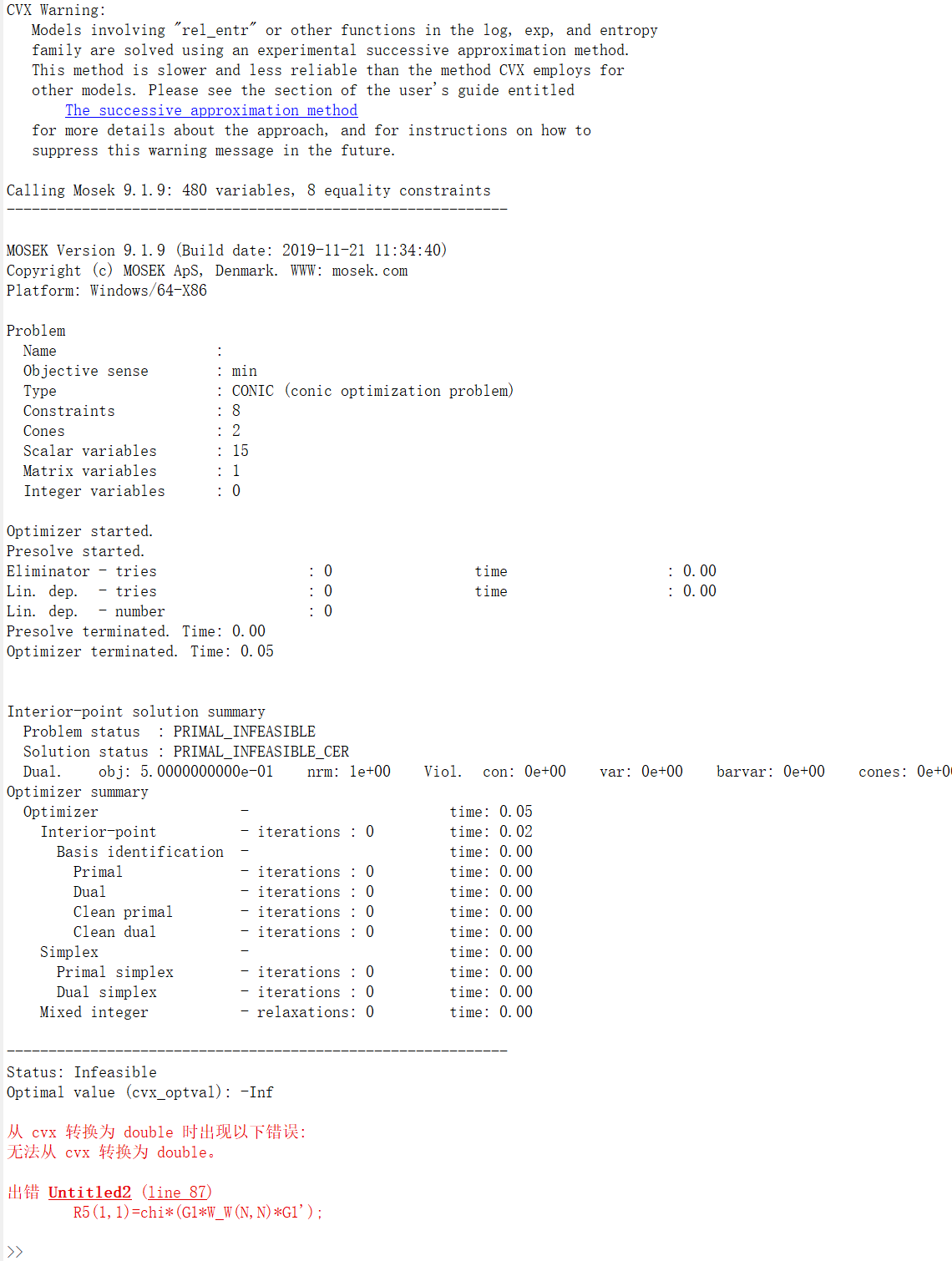
Thank you for your comments.I just didn 't change SeDuMi in the code to mosek, but now there 's a new error : Cannot be converted from cvx to double.
All outputs are as follows:


The red word means :
The following error occurred when converting cvx to double :
Cannot be converted from cvx to double.

Error Untitled2 ( line 87 )
R5 ( 1,1 ) = chi * ( G1 * W _ W ( N, N ) * G1 ’ ) ;

Y
Replying to #16

My code is as follows
close all
clc;
clear all;
%*参数设置%
K=2;%用户数量
T=1;%总时间周期
M=6;%发射天线数
N=30;%反射元件数
chi=0.8;%能量转换效率
PkC=0.005;%7dbm
Pe=0.0015;%1.8dbm
PPS=0.05;%17dbm
PIR=0.05;%17dbm
delta=10^(-6);%delta^2=-80dbm
Pmax=0.316;%25dbm
Rkmin=0.5;%bits/Hz
% Imax=10^5;%迭代次数
% Lmax=10^5;%迭代次数
% epsilon=10^-5;%允许误差
d0=10;%PS到RIS距离
d1=60;%RIS到IR距离

d01=sqrt(85);%能量站PB到RIS的距离
d02=sqrt(104);%能量站PB到WD2的距离
d11=sqrt(5);%RIS到WD1的距离
d12=2;%RIS到WD2的距离
d21=59;%WD1到信息接收机IR的距离
d22=58;%WD2到信息接收机IR的距离

% H = rice_matrix1(M,N);%306维
% G = rice_matrix2(M,N);%30
1维
H=randn(30,6);
G=randn(30,1);
H1 = abs(real(H)d01.^(-2));%306
H2 = abs(real(H)d02.^(-2));%306
h1 = abs(real(G)d11.^(-2));%301
h2 = abs(real(G)d12.^(-2));%301
G1=h1’H1;%16
G2=h2’H2;%16
h(1)=d01^(-2);%PT到ST1之间的信道增益
h(2)=d02^(-2);%PT到ST2之间的信道增益
g(1)=d21^(-2);%ST1到SR1之间的信道增益
g(2)=d22^(-2);%ST2到SR2之间的信道增益

% H1(1)=h1.*H;%PS到RIS之间的信道增益
% H1(2)=h2.*H;%PS到RIS之间的信道增益
% G1=g(1).*G;%ST1到SR1之间的信道增益
% G2=g(1).*G;%ST2到SR2之间的信道增益

opt_q1=[];
% opt_q2=[];
% opt_q3=[];
q1=10;
% q2=10;
% q3=20;

% gama=0.05;%Rn_h的中断概率
% rou=0.05;%Rn_b的中断概率
% delta_h=0.005;%Δhk的界
% delta_g=0.005;%Δgk的界

for l = 1:1:10
eta= 0.1;
% for k=1:K
% h_(1,k)=(4delta_hdelta_grou+2g(k)delta_h-2delta_hdelta_g)/log((h(k)+delta_h)/(h(k)-delta_h));
% g_(1,k)=g(k)+2
gama*delta_g-delta_g;
% end

%子问题1*
cvx_solver Mosek
cvx_begin
variable W_W(N,N) semidefinite
variables t0 t(K,1) p_p(K,1);
expressions R1(1,K) R2(1,K)
% R2(K,1) R3(K,1) R4(K,1) R5(K,1)
for k=1:K
%R1(k,1)=t(k,1)log(1+p_p(k,1)g(k)^2/(t(k,1)delta^2))/log(2);
R1(1,K)=-rel_entr(t(k,1),p_p(k,1)g(k)^2/delta^2+t(k,1));
%y=t(k,1),x=p_p(k,1)g(k)^2/delta^2;
end
% for k=1:K
% R2(k,1)=p_p(k,1);
% R3(k,1)=(t0+t(k,1))PkC;
% R4(k,1)=t(k,1)PIR;
% end
R5(1,1)=chi
(G1
W_W(N,N)G1’);
R5(1,2)=chi
(G2
W_W(N,N)G2’);
maximize sum(R1)-eta
(sum(p_p(k,1))+t0
(PPS+N
Pe)+t0
PkC+sum(t(k,1))PkC+sum(t(k,1))PIR+trace(W_W(N,N))-sum(R2));
subject to
t0+sum(t)<=T;
t0>=0;
trace(W_W(N,N))<=t0
Pmax;
for k=1:K
t(k,1)>=0;
p_p(k,1)+PkC
(t0+t(k,1))<=chi
(G1*W_W(N,N)*G1’);
R1(1,k)>=Rkmin;
end

cvx_end
q1=sum(R1)/(sum(p_p(k,1))+t0*(PPS+NPe)+t0PkC+sum(t(k,1))*PkC+sum(t(k,1))*PIR+trace(W_W(N,N))-sum(R2));
opt_q1=[opt_q1 q1];

end

Y
Replying to #18

oh,I seem to be running successfully!

J
Replying to #19

Yes, the bug in your code.