
How to solve high-dimension QCQP problem?

Uncategorized
May 18, 2022
C

Now I have a high-dimension QCQP problem.
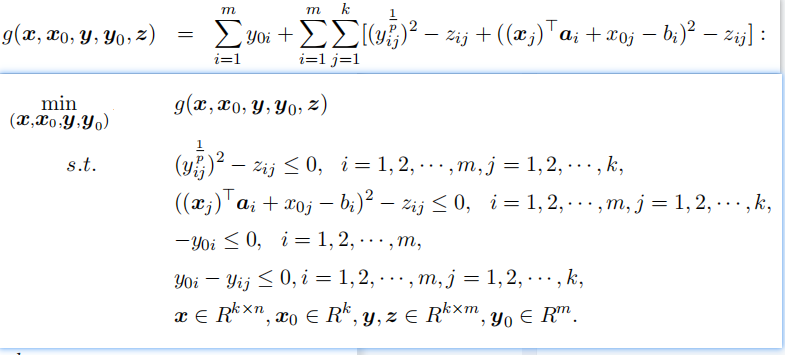
x is a high-dimension matrix.
I need to solve this problem so I can have different row matrix.
But the result is a matrix which each row is same.

x=[1,0.5;1,0.5]

This is my code.

cvx_clear

m=4;
f=1; 
k=2;

z = 10*rand(m,k);
data=[0,0;1,1;0,1;1,2];

cvx_begin
    variable x(k,f+1)   
    variable y(m,k+1)   
    minimize( sum(y(:,1)) + sum(sum(power(y(:,2:k+1),2)-z)) + sum(sum(power((x(:,1:f)*data(:,1:f)'+repmat(x(:,f+1),1,m)-repmat(data(:,f+1)',k,1)),2)-z'))   )
    subject to
        power(y(:,2:k+1),2)-z<=0;    
        power((x(:,1:f)*(data(:,1:f)')+repmat(x(:,f+1),1,m)-repmat(data(:,f+1)',k,1)),2)-z'<=0;
        (-1)*y(:,1)<=0;
        repmat(y(:,1),1,k)-y(:,2:k+1)<=0; 
cvx_end
J

It might have nothing to do with high dimension or low dimension, CVX will solve them anyway. Maybe it should be the same, we don’t know your problem too well and your data are randomly generated. and please re-format your code in Markdown format (per How do I include Matlab source code in forum posts? - #2 by mcg) so it be runnable.

C
Replying to #2

Thanks for your reply. I have finished it so you can run it.

J
Replying to #3

Try

z =

   [ 1.8047    0.0886;
    9.3060    6.7159;
    0.4515    9.0481;
    2.4065    5.7242]

you’ll get a different result.
Note that y and x are un-related variables in your problem. and your problem looks simple, I’m not sure if there is a close-form solution to it.

C
Replying to #4

Thank you very much. It helps me a lot. Besides, How did you find the value of Z?

J
Replying to #5

Run your program 3 times.

C
Replying to #6

haha thank you very much