Hello everyone!
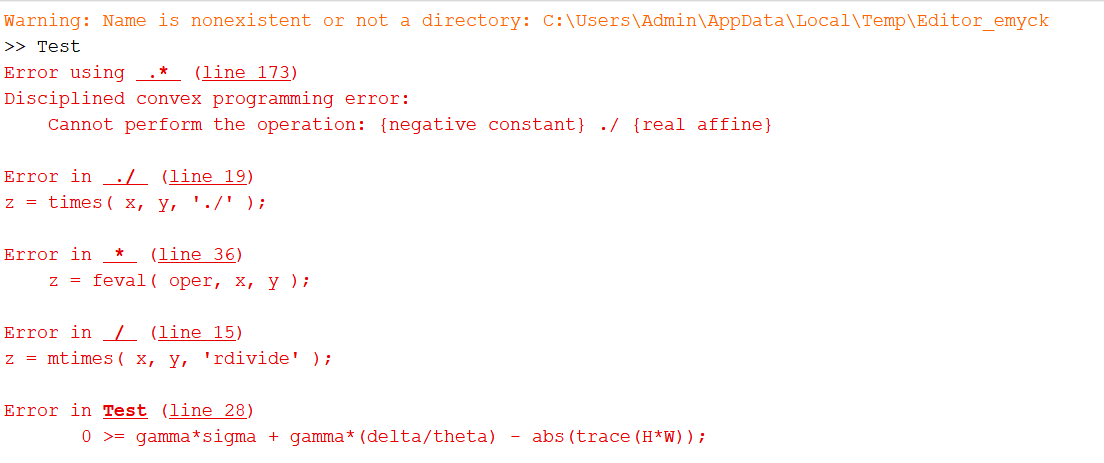
Can you help me with the problem. When i run the codes here, it’s doesn;t work right because matlab CVX do not perform divide.
M = 7;
Nt = 8;
L = 5;
Pmax = 40;
u = 0.5;
sigma = -70;
delta = -50;
SNRdB = 10;
gamma = 10.^(SNRdB/10);
Iota = 40;
h = zeros(Nt,M);
g = zeros(Nt,L);
for i=1:M
              h(:,i) =sqrt(1/2)*(randn(Nt,1)+1i*randn(Nt,1)); % Nt antenna to 1 SR
end
for i=1:L
              g(:,i) =sqrt(1/2)*(randn(Nt,1)+1i*randn(Nt,1)); % Nt antenna to 1 PU
end

H = (h*ctranspose(h));
G = (g*ctranspose(g));
cvx_begin
    variable W(Nt,Nt)
    variable theta
    minimize(0);
    subject to
       0 >= abs(trace(W))-Pmax;
       0 >= gamma*sigma + gamma*(delta/theta) - abs(trace(H*W));
       0 >= abs(trace(G*W)) - Iota;
       0 < theta < 1;
       W >= 0;
cvx_end
------------------------------
**It’s appear the error. **
The constraint
0 >= gamma*sigma + gamma*(delta/theta) - abs(trace(H*W));
is not convex.
The term gamma*(delta/theta) can be rewritten as gamma*delta*inv_pos(theta) , but because gamma*delta is negative, that term is concave, and therefore makes the constraint non-convex.
Even if gamma*delta were positive, the term -abs(trace(H*W) is also concave, and makes the constraint non-convex.
If you have a typo, and really meant >= rather than <=, use of inv_pos would allow the constraint, and the whole program, to be accepted by CVX.
I’m researching the topic “Simultaneous Wireless Information and Power Transfer Solutions for Energy Harvesting Fairness in Cognitive Multicast Systems”. I’m stuck in simulate the formula number 9 based on formula number 7 follow table 1 (in sec1 & 2)
Can you help me with the problem i said.
I’m looking forward to hearing from you
You are having trouble with (7d).
Your implementation has abs, but (7d) does not. That addresses one of the non-convexity sources.
Your other non-convexity source is because your delta is negative. It would seem delta should be positive, which would make the constraint convex.
Hello Mark.
I’m beginer when start CVX. It’s difficult for me to simulate. So can I get the code for this part from you? I’m looking forward from you.
Have a nice day Mark!
You need to do some work yourself. it is your project, not mine.
I toid you not to have the abs in the code. Additionally, your input data needs to be fixed (delta must be positive). i don’t know how the input data is determined, but that is for you to figure out.
More generally, Successive Convex Approximation is a very precarious endeavor, as I describe in various posts on this forum. When used by someone who is not a real expert, it often meets with failure.