
Cvx_status=unbounded in Benders subproblem

Uncategorized
May 28, 2020
G

The Benders Subproblem is as follows:
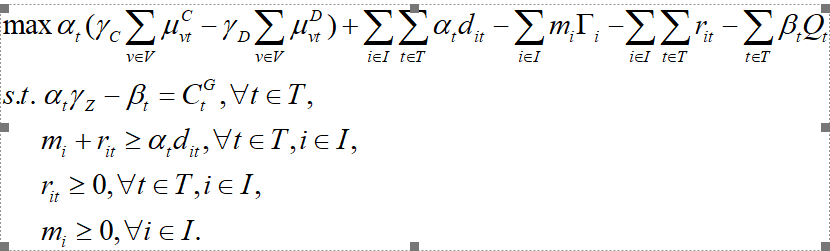

The decision variables:\alpha_t, \beta_t,r_{it},m_i,and others are known parameters.

Soving the problem by Python+gurobi ,the output is as follows:

Gurobi Optimizer version 9.0.1 build v9.0.1rc0 (win64)
Optimize a model with 45 rows, 58 columns and 126 nonzeros
Model fingerprint: 0xc76df5b0
Coefficient statistics:
Matrix range [9e-01, 2e+02]
Objective range [1e+00, 2e+03]
Bounds range [0e+00, 0e+00]
RHS range [5e-01, 8e-01]
Presolve removed 45 rows and 58 columns
Presolve time: 0.01s
Presolve: All rows and columns removed
Iteration Objective Primal Inf. Dual Inf. Time
0 1.2182075e+04 0.000000e+00 0.000000e+00 0s

Solved in 0 iterations and 0.01 seconds
Optimal objective 1.218207529e+04

Where Model.satus=2,which means the optimal solution is available. The optimal objective is equal to 12182.The problem is bounded.

Soving the problem by Matlab+cvx+mosek ,the output is as follows:
Calling Mosek 9.1.9: 115 variables, 50 equality constraints

MOSEK Version 9.1.9 (Build date: 2019-11-21 11:34:40)
Copyright © MOSEK ApS, Denmark. WWW: mosek.com
Platform: Windows/64-X86

Problem
Name :
Objective sense : min
Type : LO (linear optimization problem)
Constraints : 50
Cones : 0
Scalar variables : 115
Matrix variables : 0
Integer variables : 0

Optimizer started.
Presolve started.
Eliminator started.
Freed constraints in eliminator : 0
Eliminator terminated.
Eliminator - tries : 1 time : 0.00
Lin. dep. - tries : 0 time : 0.00
Lin. dep. - number : 0
Presolve terminated. Time: 0.03
Optimizer terminated. Time: 0.13

Interior-point solution summary
Problem status : DUAL_INFEASIBLE
Solution status : DUAL_INFEASIBLE_CER
Primal. obj: -1.6005008384e+03 nrm: 2e+02 Viol. con: 0e+00 var: 0e+00

Basic solution summary
Problem status : DUAL_INFEASIBLE
Solution status : DUAL_INFEASIBLE_CER
Primal. obj: -1.6005008384e+03 nrm: 2e+02 Viol. con: 0e+00 var: 0e+00
Optimizer summary
Optimizer - time: 0.13
Interior-point - iterations : 0 time: 0.05
Basis identification - time: 0.00
Primal - iterations : 0 time: 0.00
Dual - iterations : 0 time: 0.00
Clean primal - iterations : 0 time: 0.00
Clean dual - iterations : 0 time: 0.00
Simplex - time: 0.00
Primal simplex - iterations : 0 time: 0.00
Dual simplex - iterations : 0 time: 0.00
Mixed integer - relaxations: 0 time: 0.00


Status: Unbounded
Optimal value (cvx_optval): +Inf

Where the cvx_status=unbounded, which means the optimal solution doesn’t exist.

Question: The results obtained by the two solvers are different. And we guess whether it is caused by cvx?

M

We don’t even know that your two codes are mathematically equivalent, leaving aside any transformations which might be done in the different environments.

G
Replying to #2

Thank you for answering. The two codes are as follows.
#python+gurobi
from numpy import*
import numpy as np
from gurobipy import*
import pandas as pd
#create a new model
model = Model(“Benders_SP”)
#Initialize coefficient matrix
model.Params.InfUnbdInfo = 1
excel_path= r’D:\software\gurobi_9\win64\examples\python\Benders\data.xlsx’
x=pd.read_excel(excel_path,‘x’)
y=pd.read_excel(excel_path,‘y’)
A=pd.read_excel(excel_path,‘A’)
Cc=0.1
Cg=[0.746547776,0.755680707,0.603636527,0.491336073,0.770983328,0.480292946,0.668648765,0.588128497,0.737004972,0.41018244]
d=pd.read_excel(excel_path,‘d’)
d_row=[1921.200755,1839.120405,1989.963025,1732.989174,1803.393696,1997.270359,1933.796329,1853.403336,1855.891279,1950.227868]
GAMA=np.array([[0,0,0,0,0]]).T
p=0.09
Q=[550,550,550,550,550,550,550,550,550,550]
rc=7.5
rd=6.25
xitao=0.5
gammaC=0.95
gammaD=0.9
gammaZ=0.9
#create variables
alpha={}
beta={}
m={}
r={}
for t in range(0,9):
alpha[t]=model.addVar(name=“alpha(%s)”%(t))
beta[t]=model.addVar(lb=0,name=“beta(%s)”%(t))
for i in range(0,4):
m[i]=model.addVar(lb=0,name=“m(%s)”%(i))
for i in range(0,4):
for t in range(0,9):
r[i,t]=model.addVar(lb=0,name=“r(%s,%s)”%(i,t))

#create constraints
model.addConstrs(gammaZ*alpha[t]-beta[t] == Cg[t] for t in range(0,9))
model.addConstrs(m[i]+r[i,t] >= alpha[t]*d.iloc[i,t]*xitao for i in range(0,4) for t in range(0,9))

#set objective
obj = LinExpr()
obj += sum(alpha[t](gammaCsum(x.iloc[i,t]rc for i in range(0,4))-gammaDsum(y.iloc[i,t]*rd for i in range(0,4))) for t in range(0,9))
obj += sum(alpha[t]*d_row[t] for t in range(0,9))
obj += sum(-m[i]*GAMA[i] for i in range(0,4))
obj += sum(-beta[t]*Q[t] for t in range(0,9))
obj += sum(r[i,t] for i in range(0,4) for t in range(0,9))
model.setObjective(obj, GRB.MINIMIZE)
model.optimize()
a=model.getAttr(GRB.Attr.UnbdRay, model.getVars())
print(a)

#matlab+cvx+mosek

function [alpha1,beta1,r,m,phi,BD_status,UB1]=Benders_SP(x,y, A, Aa, B, Bt, Cc, Cg, cmu, cxigma, d, GAMA, i, j, p, pxita, Q, rc, rd, t, t3, v, v3, w, xitao, gammaC, gammaD, gammaZ)
parameters;
cvx_begin
cvx_solver mosek
%create variables————————————————
variable alpha1(1,t)
variable beta1(1,t) nonnegative
variable phi(1,1) nonnegative
variable m(i,1) nonnegative
variable r(i,t) nonnegative
%set objective function——————————————————
maximize (sum(alpha1.(gammaCsum(x.rc,1)-gammaDsum(y.rd,1)))+sum(alpha1.sum(d,1))-sum(m.GAMA+sum(r,2))-sum(beta1.Q))
% (sum(alpha1.
(gammaC
sum(rc
x,1)-gammaD
sum(rdy,1)))-sum(beta1.Q)+phi)
subject to
%Constraint(4.24)、(4.27)——————————————————
for t1=1:t
gammaZ
alpha1(t1)-beta1(t1) == Cg(t1);
end
% gammaZ.
(alpha1)-beta1 == Cg;
% sum(alpha1.*sum(d,1))-sum(m.*GAMA+sum(r,2))>=phi;
for t1=1:t
for i1=1:i
m(i1)+r(i1,t1)>=alpha1(t1)*d(i1,t1).*xitao;
end
end

cvx_end
BD_status=cvx_status;
UB1=cvx_optval;function [alpha1,beta1,r,m,phi,BD_status,UB1]=Benders_SP(x,y, A, Aa, B, Bt, Cc, Cg, cmu, cxigma, d, GAMA, i, j, p, pxita, Q, rc, rd, t, t3, v, v3, w, xitao, gammaC, gammaD, gammaZ)
parameters;
cvx_begin
cvx_solver mosek
%create variables————————————————
variable alpha1(1,t)
variable beta1(1,t) nonnegative
variable phi(1,1) nonnegative
variable m(i,1) nonnegative
variable r(i,t) nonnegative
%set objective function——————————————————
maximize (sum(alpha1.(gammaCsum(x.rc,1)-gammaDsum(y.rd,1)))+sum(alpha1.sum(d,1))-sum(m.GAMA+sum(r,2))-sum(beta1.Q))
% (sum(alpha1.
(gammaC
sum(rc
x,1)-gammaD
sum(rdy,1)))-sum(beta1.Q)+phi)
subject to
%Constraint(4.24)、(4.27)——————————————————
for t1=1:t
gammaZ
alpha1(t1)-beta1(t1) == Cg(t1);
end
% gammaZ.
(alpha1)-beta1 == Cg;
% sum(alpha1.*sum(d,1))-sum(m.*GAMA+sum(r,2))>=phi;
for t1=1:t
for i1=1:i
m(i1)+r(i1,t1)>=alpha1(t1)*d(i1,t1).*xitao;
end
end

cvx_end
BD_status=cvx_status;
UB1=cvx_optval;

E

Based on the output I am 99.9999% sure that the problem Mosek is fed is dual infeasible.