I am trying to simulate the following convex problem:
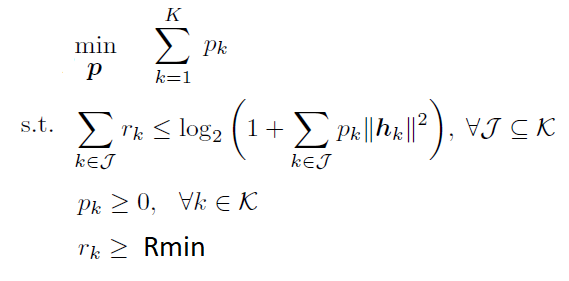
Basically, trying to minimize the power of two users in UL transmission which are assigned to the same subcarrier of a BS. Therefore, interference is also included for the calculation of the rate.
However, only the interference of the weak user h_w < h_s is included, assuming the strong user can apply a Successive interference cancellation (SIC) technique.
I have formulated the following code, but I must have done something wrong because I get the following error message: Cannot perform the operation: {real affine} ./ {real affine}
Can I get some feedback please, so I can figure out what I am doing wrong?Preformatted text
K= 2;
R_min = 10^-2;
Power_total = 10;
h = complex(randn(2,1),randn(2,1))/sqrt(2); %CSI

cvx_begin
    variable p(2) nonnegative
    minimize sum(p)
    subject to
        expression Interference(1,2);
        for i=1:K
            Interference(i) = 0;
            for j=1:K
                if (i ~= j) && (abs(h(i)) > abs(h(j)))
                    Interference(i) = Interference(i) + p(j)*norm(h(j))^2;
                end
            end
        end

        % Minimum rate
        log(1+p(1)*norm(h(1))^2/(1+Interference(1))) >= R_min
        log(1+p(2)*norm(h(2))^2/(1+Interference(2))) >= R_min

        % MAC contraints
        log(1+p(1)*norm(h(1))^2/(1+Interference(1))) <= log(1+p(1)*norm(h(1))^2)
        log(1+p(2)*norm(h(2))^2/(1+Interference(2))) <= log(1+p(2)*norm(h(2))^2)
        log(1+p(1)*norm(h(1))^2/(1+Interference(1)))+log(1+p(2)*norm(h(2))^2/(1+Interference(2))) <= log(1+p(1)*norm(h(1))^2 + p(2)*norm(h(2))^2)

        sum(p) <= Power_total
        p >= 0
cvx_end
The error is occurring in the constraint
log(1+p(1)*norm(h(1))^2/(1+Interference(1))) >= R_min
because Interference(1) is (equal to) p(1)
This constraint is convex because the LHS is conccave in p(1).
You ought to be able to use the approach, modified to handle the norm(h(1))^2 multiplying p(1). in @Michal_Adamaszek’s answer in Can CVX solve this kind of function {x-log(1+x/(x+1))} which will be DCP-compliant, and hence accepted by CVX.
The constraint
log(1+p(2)*norm(h(2))^2/(1+Interference(2))) >= R_min
is o.k. as is because Interference(2) = 0.
However, the MAC constraints violate the DCP rules, and will be rejected by CVX. Why isn't CVX accepting my model? READ THIS FIRST! . The 2nd of these MAC constraint trivially holds, and so can be eliminated.
However, the first MAC constraint is non-convex; if the constraint is formulated as LHS - RHS <= 0, then LHS -RHS has 2nd derivative with respect to p(1) being either positive or negative for various values of p(1) >= 0; therefore it is non-convex I haven’t checked the convexity of the 3rd of the MAC constraints.
You are right, the MAC constraints violate the DCP rules, and will be rejected by CVX.
About @Michal_Adamaszek 's answer in Can CVX solve this kind of function {x-log(1+x/(x+1))} , it’s not the same case because Interference(1) = p(2)*norm(h(2))^2. Therefore, in my case becomes:
log(1+x/(1+y))
which cannot be solved with the way @Michal_Adamaszek has proposed
I wrote
modified to handle the norm(h(1))^2 multiplying p(1).
Just use norm(h(1))^2 in place of 0.01 in @Michal_Adamaszek’s answer.
I.e.,
multiplier = norm(h(1))^2;;
log(1 + multiplier - multiplier*inv_pos(p(1)+1)) >= R_min
This solution works for any value of multiplier which is nionnegative.
How can i write the following constraints, so that cvx would accept it?
 r(1) >=  log( 1+p(1)*norm(h(1))^2 / (1 + p(2)*norm(h(2))^2))

 r(2) >=  log( 1+p(2)*norm(h(2))^2 / (1 + p(1)*norm(h(1))^2))
Those constraints are not convex. The right-hand sides are indefinite, i.e., neither convex nor concave. The numerators inside the log are “going the wrong way”.