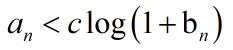
when you transform it to an<=c*log(1+bn) ,in order to be accepted by cvx,the left side must be convex
and the right must be concave,log(1+bn) are concave when (1+bn) are concave and >0; which have menthioned in Convex optimization in part3,不说了,急着出门。 
I have deleted my previous reply, because it is incorrect.
I think so. however, thanks for your kind attitude.
This is an English language forum. Thank you.
Yes, i know. As for the problem itself, I try to use English as much as i can.
In your previous reply, if the a_n is a binary variable, is it possible to use a slack variable to replace d_n*b_n ?
Section 2.8 of https://www.fico.com/en/resource-access/download/3217 shows how to linearize the product of binary variable with continuous variable.
ok, i saw this pdf in your previous answer in other posts, maybe it can help, thanks.
You can do variable substitution. Firstly, you should define x_n =\frac{a_n}{\log(1+b_n)}, \frac{a_n}{\log(1+b_{n}^{max})} \leq x_n \leq \frac{a_n}{\log(1+b_{n}^{min})}. Secondly,
you can replace \frac{a_n}{\log(1+b_n)} in the expression with x_n. Then, you have a new expression \sum_{n=1}^{N}x_n \leq c, \\
\textbf{s.t.} \frac{a_n}{\log(1+b_{n}^{max})} \leq x_n \leq \frac{a_n}{\log(1+b_{n}^{min})}. Finally, the above expression is a convex set.
@Yenfy I presume you are assuming a_n \ge 0.
Perhaps your formulation assumes a_n and b_n do not appear elsewhere in the model?
How are a_n and b_n recovered from x_n?
I,m sorry, it’s my fault. I thought a_n was a parameter. If a_n is a variable, my above solution is wrong.
@Yenfy If a_n were a parameter and b_n is constrained to be >= 0, the easiest thing to do in CVX would be
sum(a.*inv_pos(log(1+b))) <= c
When I use inv_pos() in CVX (not this problem.), the result usually become infeasible.  ,but when I comment out the constraint contains inv_pos() expression, it can be solved and the result can satify the commented consraints.
  , that’s very confusing.
@TomK Please provide a reproducible example, clearly showing what you say.
I have some new questions about function quad_over_lin()
It seems that y cannot be a vector?
if x, y are all 1×N vectors, how to formulate sum(x(n)^2/y(n)) in CVX, N is a large constant, so I cannot formulate it as ((x(1)^2/y(1)) +(x(2)^2/y(2)) +…+(x(n)^2/y(n))) in CVX because it is too long.
I want to minimize 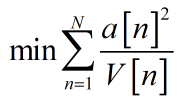
This is my code:
%%%%%%%%%%%%%%%%%%%%%%%%%%
cvx_begin
% cvx_solver SeDuMi
cvx_solver SDPT3
cvx_precision low
variable a(5)
variable V_slack(5)
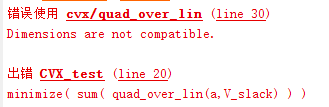
minimize( sum( quad_over_lin(a,V_slack) ) )
…
The error becomes


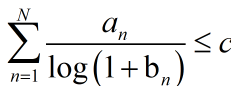 seems nonconvex, where a_n and b_n are variables, c is a constant. is it possible to transform it into a convex expression??
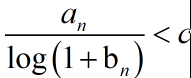 can be convex since it can be transformed to
  .)
.)

 ,but when I comment out the constraint contains inv_pos() expression, it can be solved and the result can satify the commented consraints.
  , that’s very confusing.
