My code is as follow:
cvx_begin
variable x;
minimize(x-1000*log(1+0.01*x/(x+1));
subject to
x>0;
cvx_end
Then it reported:
Disciplined convex programming error:
Cannot perform the operation: {real affine} ./ {real affine}
log(1+x/y) is a kind of formation of Information entropy,and my obj function is concave. Is there any ways to rewrite this object function ? Thank you.
What if you write it as x-1000*log(1.01-0.01*inv_pos((x+1))). I’m not sure this is correct cvx syntax, I just mean transform the expression like this.
Well,This is a problem. I just don’t know what kind of expression it should be converted into.And x-1000*log(1+0.01*x*inv_pos(x+1)) reported another error:
Cannot perform the operation: {positive constant} ./ {real affine}
Or I don’t know if it can solve this problem just like this expression
All I know is that my expression is equivalent to yours and conic representable. I’m not sure it implies it also works in cvx but if not it should be only a matter of me making a syntax error.
@Michal_Adamaszek 's solution is correct, and is accepted and solved by CVX.
cvx_begin
variable x
minimize(x-1000*log(1.01-0.01*inv_pos((x+1))))
subject to
x>0
cvx_end
@04014540 Can you show us the complete program you ran which triggered the error message Cannot perform the operation: {positive constant} ./ {real affine} ?
Sorry,I just found my mistake.@Michal_Adamaszek 's solution is right.Thank you so much and I can use a model that similar to this to solve the problem about Information entropy.Best wish to you.
Yes,your solution is correct.Thank you!
Good afternoon. I have met a relevant about Information entropy question like log(1+1/x)<a. Would you mind send your problem and the corresponding solution to me? It might be a great honor for me to receive your reply. Many thanks!
I have also same problem, Please help me
maximize(Mn-mu_n*(1+exp(-an*(gnx*(P(1)+P(2))-bn))))
subject to
 R1 = log2(1+(P(1)*hix)*inv_pos(P(2)*hix)+Ni);
 R2 = log2(1+(P(2)*hjx)*inv_pos(Nj));
 R3 = log2(1+(P(1)*hjx)*inv_pos((P(2)*hjx)+Nj));
 R1 >= R_min;
 R2 >= R_min;
 R3 >= R1+R2;
Getting Error
Cannot perform the operation: {real affine} .* {convex}
Error in * (line 36)
z = feval( oper, x, y );
Error in nov22 (line 41)
R1 = log2(1+(P(1)*hix)*inv_pos(P(2)*hix)+Ni);
hi
my problem as follows:
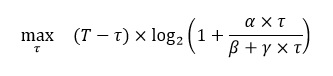
where t is optimization variable and t <=T and alpha, beta and gamma >0 and real number.
how can rewrite T * log (1+a *x / (b + g *x)) in cvx?
for b and g in the de-numerator, I can’t use the same method
Your remaining piece looks something like log(1+0.01*x/(x+1)) . Make the necessary adaptation. It’s your problem, so you should put in at least some of the effort.
I can’t use this method because I can’t reform the de-numerator to (1+x)
i know a *x / (b + g *x) is can be concave and convex in the domain and DCP can’t perform what is… and I must use inv_pos(.) to define for DCP.
i used a x * inv_pos(b + g * x) but give :Cannot perform the operation: {real affine} . {convex}
i think a *x term must import to inv_pos() function or rewrite a *x / (b + g *x) as affine function for t and use inv_pos() but I can’t…
Let aa = a/g; bb=b/g;
log(1+aa*t/(bb+t)) = log(1+aa-aa*bb*inv_pos(bb+t)), the latter of which complies with CVX’s rules.
So this generalizes (adapts) the reformulation provided above by @Michal_Adamaszek to bb not necessarily equal to 1.
Hi,
I am trying to apply CVX on my optimization problem wich is concave with linear constraint but it does not work! The error is “Cannot perform the operation: {real affine} ./ {real affine}”
fA = f_max *ones(1,K); fB = f_max *ones(1,K);
           cvx_begin
                    variable EA(1,K)
                    variable EB(1,K)
                    variable t_uA(1,K)
                    variable t_uB(1,K)
                    variable t
                    % Define the concave objective
                    maximize BW * sum (t_uA.*log(1+(EA.*h_uAT1)./(t_uA.*Noise_Pr))) + BW * sum (t_uB.*log(1+(EB.*h_uBT1)/(t_uB.*Noise_Pr)))
                    % Add linear constraints
                    subject to
                        EA <= eta_max(q) * P_max(l) * t * h_eA - a*fA*T_max(m);
                         EB <= eta_max(q) * P_max(l) * t * h_eB - a*fB*T_max(m);
                        T_max(m) - sum(t_uA) - sum(t_uB) - t == 0;
            cvx_end
I can prove here my objective is concave. We all know log(1 + X) is concave. According to a theorem in convex optimization, when f(X) is concave, Yf(X/Y) is concave as well. Consequently, the sum of them is concave. Then, my objective function is concave where X = EA and Y = t_uA. Similarly, we can say for the second term of objective function!
Thank you in advance
That can be put in the form x*log(1+y/x) which can be reformulated for CVX as -rel_entr(x,x+y)
In this case, x is t_uA and y is EA.*h_uAT1./Noise_Pr
and you can use sum(-rel_entr(x,x+y))